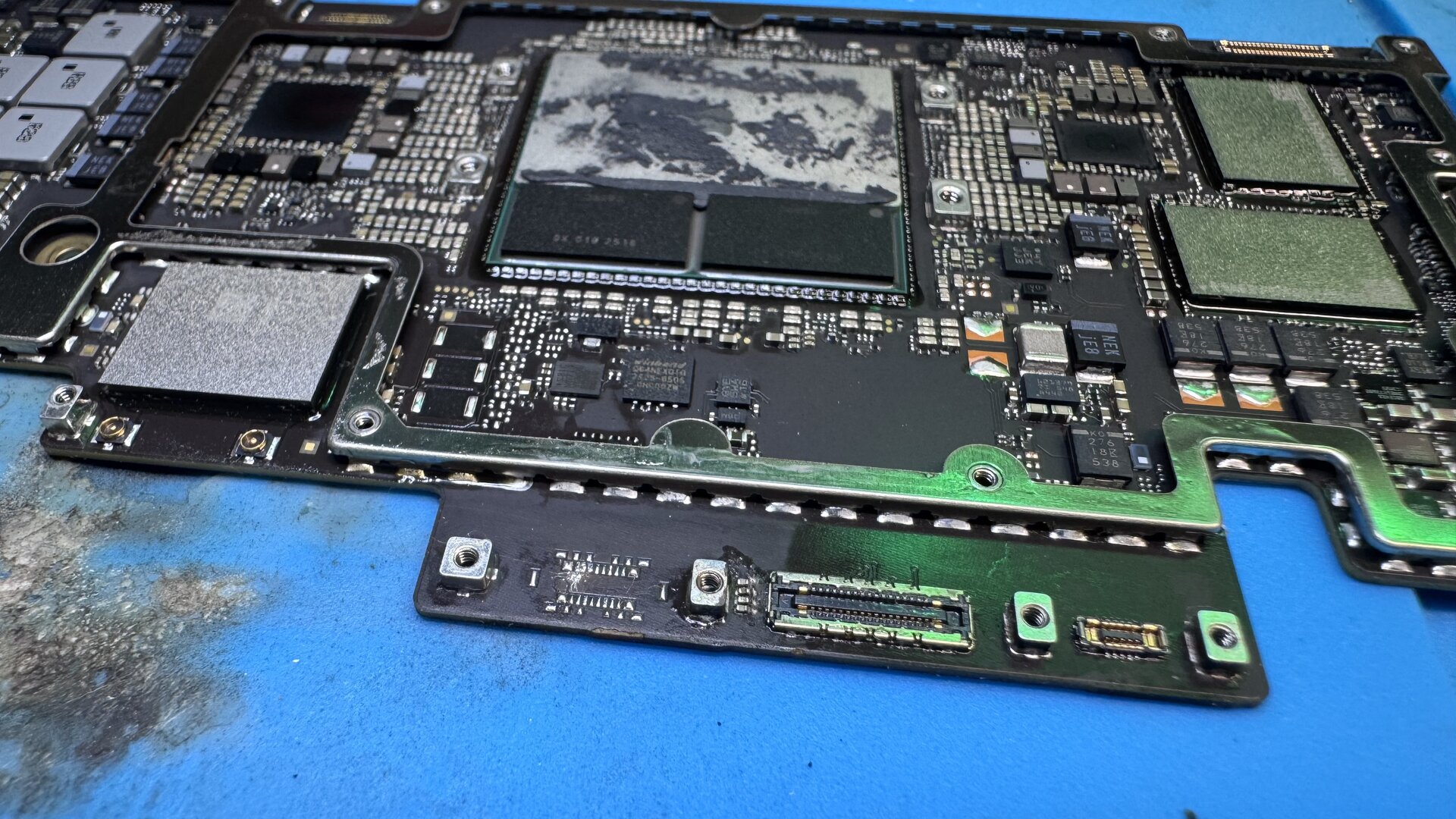
MacBook Logic Board Repair Cost
Component-level micro-soldering vs. Apple's full board replacement
Every Mac repair is performed in-house using genuine Apple parts.
Quick Answer
Component-level logic board repair at WarriorMac costs from $199 to $799. We repair the actual failed component using micro-soldering rather than replacing the entire board. Apple charges $600-$1,500+ for a full logic board replacement. Our approach also preserves your data on Macs with soldered storage.
Cost Breakdown by Model
See what each repair costs at WarriorMac versus a typical Apple Store quote.
Simple fuse / connector repair
Power management IC (PMIC) repair
USB-C / Thunderbolt controller repair
GPU / display output repair
Multi-component liquid damage repair
Please note: All prices shown are estimates provided only to give you an approximate idea of the cost. Final pricing varies from one machine to another and depends on the severity of the issue. These price ranges do not include labor. We always provide a free diagnostic and an exact quote before any work begins.
What Affects the Cost
Type of failure
A simple blown fuse ($199-$299) is less complex than a multi-component power management failure ($400-$600) or a GPU-related repair ($499-$799).
Extent of damage
Single-component failures are straightforward. Liquid damage that has corroded multiple components requires more extensive work and costs more.
MacBook model
Newer Apple Silicon models have more complex board layouts. The cost of replacement components also varies by model and generation.
Diagnostic complexity
Some failures are immediately identifiable under a microscope. Others require extensive signal tracing with schematics, thermal imaging, and systematic testing.
WarriorMac vs. Apple Store
Apple's standard approach is to replace the entire logic board at $600-$1,500+, because they do not perform component-level repair. This also means losing your data on Macs with soldered storage (all Apple Silicon and T2 Macs). WarriorMac fixes just the failed component, saving you hundreds and keeping your data intact.
Board repair compared with board replacement
A logic board rarely dies as a whole. Far more often a single part on it has failed, most commonly a shorted capacitor on a power rail, a burned inductor, a failed charging IC after a cheap adapter, or a corroded trace from a spill. Component-level repair addresses that specific part and costs a fraction of a whole board.
It also keeps the original board, and on Apple silicon and T2 Macs that matters more than the money. The SSD is soldered to the board and encrypted to the Secure Enclave, so replacing the board throws away everything still stored on it. Touch ID pairing and the machine serial number go with the old board too.
We test the rails under load rather than at idle, because a failing board frequently measures acceptable until it is asked for current. That is what tells us whether a repair will hold or whether you are being sold a reflow that lasts a month.
How to tell a board fault from something cheaper
No response at all from the power button, a fan that spins with no display and no chime, a machine that runs for a few seconds and shuts down, or one that only boots with the charger in one specific port are the classic board symptoms. But the last of those is often the I/O board rather than the logic board, and that is a far smaller bill.
On an iMac, the LED1 diagnostic light next to the memory slots should illuminate as soon as the machine is plugged in, before the power button is touched. If LED1 stays dark, the power supply is not delivering standby power. If LED1 lights but LED2 never does, the board is failing to come out of standby and the fault is on the board.
Free diagnosis exists precisely so you are not paying to find out which of these it is. We open the machine, inspect the board under a microscope, take the measurements and tell you the number before any work is authorised.
Turnaround and warranty on board work
Most board-level repairs are completed in three to five business days, because the board has to come out, be cleaned, be reworked under a microscope and then be tested under sustained load before it goes back in. Rushing that step is how a repair comes back.
Board-level repairs carry a 180-day warranty, the same as pre-owned parts. Brand new parts carry a full year. If the same fault returns inside that window we deal with it, and we will tell you at quote time if a board is too far gone to stand behind rather than taking the job anyway.
Frequently Asked Questions
How much does MacBook logic board repair cost?
Component-level logic board repair at WarriorMac ranges from $199 to $799 depending on the type and complexity of the failure. This is typically 50-75% less than Apple's full board replacement.
What is the difference between repair and replacement?
We repair the specific failed component on the board using micro-soldering. Apple replaces the entire board. Repair is cheaper and preserves your data. Replacement costs more and means losing data on Macs with soldered storage.
Can all logic board failures be repaired?
Most can. If the CPU/SoC itself is damaged (rare), the board cannot be economically repaired. We diagnose every board for free and give you an honest assessment before any work begins.
Will I lose my data with logic board repair?
No. Component-level repair preserves the original board and all data on it. This is especially critical on Apple Silicon and T2 Macs where the SSD is soldered to the board.
How long does logic board repair take?
Most logic board repairs are completed in 1-3 business days after we receive your device. Complex multi-component repairs may take up to 5 days.